Posts

Showing posts with the label catch method

"Local" Silver Dory

Image
Silver Dory, zenopsis conchifer (aka. American dory, local dory) is a deep water species of benthic fish that can be found in Atlantic waters, it is related to John Dory but differs in appearance being much more slender and compressed with monochromatic silver coloring in adults, and lacking the bold black "thumb print", although juveniles of this species may have similar light markings that fade with age. The dory is a good food fish with firm mild flavored white flesh and a fine flake. The fillets are rather thin and yield is only about 25% meat from whole fish. The range of this dory in the Americas is from Nova Scotia's Sable Island and south to the Carolinas. The silver dory is a deep water species and is found from 60 meters to 600 meters depths, most being found in depths near 150 meters on or near the continental shelf. There is no targeted fishery for dory and most are caught as incidental bycatch in deep water trawls (ie. deep water loligo squi...

Fall Seafood Suggestions

Image
Here is the short list of my recommended sustainable seafood choices for Fall. These selections should be readily available until the start of winter. As usual the list has an East Coast bias, my apologies to the West Coast. So in no particular order: bluefish: wild line caught, USA clams: wild or farmed, hand dredge, USA mussels: rope grown, Canada wild striped bass: wild caught and tagged, USA bay scallops: wild and farmed, hand dredge, USA and Mexico coho salmon: wild caught, USA and Canada wild shrimp: wild caught w/excluder devices, USA arctic char: closed system farmed, Canada and Iceland catfish: farmed, USA sable fish: wild caught, USA

SEAFOOD MISSED POINTS

Since it has been some time since my last post, and I have been neglectful with only sporadic information being shared I submit to you a list of things I should have written about. Ocean Acidification Jeremy Piven Mercury misgivings Bluefin Tuna depletion and politicking Greenpeace retail rankings and rants The TV show about Sword fishing Pollack and Hoki in crisis Lower than expected wild salmon catches (again) Economic factors in the seafood industry (hint it is the most expensive protein). Seals eating salmon, and sharks eating seals. Giant squid reports ( more than a few) Jellyfish More species misrepresentations. Various Seafood Festivals Water offsets in Aquaculture et al With apologies, Matt

Tag Those Fish for Cash and Sustainability

Image
I think this is brilliant, and a harbinger of things to come. Maybe some of our East Coast fishermen will try this here. If you are a local fisherman here in the Northeast give me a call I want your well handled hand-lined fish. Story below from Seafood Source. Tagged sea bass, lobster deliver price premium By Lindsey Partos, SeafoodSource contributing editor, reporting from Paris 8/5/2009 11:03:46 AM - South East England fishermen participating in a trial tagging scheme are receiving premium prices for their line-caught sea bass and pot-harvested lobsters . Under the aegis of the South East Seafood Group, the trial is designed to promote the region’s inshore fishing fleet as a source of high-end, locally caught seafood. “The main driver for the tags is full traceability,” David Marshall of fisheries consulting firm Fathom Marine, which is leading the initiative, told SeafoodSource. Consumer demand for traceable seafood products is accelerating, he added. “Up until now,...

The Stripers are Coming

Image
Wild striped bass season opened July 1st for New York commercial fishermen. While we have had striped bass in the New York market for some time the opening of the local fish will help drive prices downward. Look for prices to drop after Independence day. Striped bass ( Morone saxatilis ), also known as rockfish to some are one of the east coasts most valuable species. Striped bass was once over fished but over the past ten years most states have implemented strict guidelines for the commercial sales of this fish as well as fair catch limits for the recreational fisherman. However this fragmented regulation from state top state has made enforcement difficult. Below is a list of some Northeast state regulations. Rhode Island trap: 26" min general category: 34" min New York 24" - 36" Delaware 28" min 20" special spring season 3/1-3/30 Maryland Bays and Rivers: 18"-36" Ocean: 24" PRFC ( Potomac River Fisheries Commission ) 18" min al...

SUSTAINABLE SPRING SEAFOOD SUGGESTIONS

In no particular order, but with some leaning towards the northeast. All products should be consistently available fresh this spring and early summer. barramundi , farm raised, United States pollack , wild, mid-trawled, Atlantic and Pacific wild salmon , wild, seine net and line caught. catfish , farmed, United States pacific halibut , wild, line caught, United States and Canada mackerel , wild, net and line caught, Atlantic oysters, all varieties farmed and wild bay scallops, look for Taylor Bays and fresh Mexican bays Squid, wild, Worldwide clams and mussels, especially hand dug, or suspended, United States and Canada crayfish, wild and farmed, United States Arctic Char , farmed Canada and Iceland. This list should provide any creative chef or home cook a season of recipes. Your comments and questions are welcome. I have provided links above to help answer some questions you may have. For more about sustainable seafood choices please visit one or more of these sites: Blue Ocean Ins...

Aquaculture Efficiencies

Image
It is estimated that in the near future ( some put the date at 2050 ) our oceans will no longer be able to support the growing seafood demand. In order to keep pace with demand fish farming (aquaculture) production is sure to increase. Now despite all the bad publicity that fish like farmed salmon receive, there are aquaculture operations that are on the cutting edge of sustainability. One in particular is Kona Blue Water Farms , where they raise Kona Kamapchi ( Seriola rivoliana ) a fish that would be known as Almaco Jack or kahala in the wild. I recently read a report they released that shows that the feed efficiency for farmed fish may in fact surpass wild fish. While the jury is still out because the report is subjective, I applaud the effort. Kona Blue is indeed doing the right thing and have received a lot of attention for the high level of stewardship they exhibit. What follows is the press release. Kona Kampachi® - 60 Times Less Impact on Stocks than Wild-Caught Fish S...

Seafood Tidbits

Image
French fishermen protest quotas by blocking transit. Chinese could eat all of Florida's turtles. Shad and the wheels of politics, fortune wanes.

Accepting the Challenges of Sustainable Seafood

I am always glad to see seafood sustainability in the public realm. I was inspired by this recent New York Times editorial .Like many issues today there is, as the author points out, a lot of confusion and bad information being bantered about. There is unfortunately a perception that farmed is bad (sometimes true) and that wild caught is better (not always the case). I am a fishmonger in New York and even some of the most savvy chefs are just starting to address this issue. Much of the problem of seafood sustainability I think is the general disconnect that the American consumer has developed with food. When I try to sell some sustainable species like mackerel (a small oily and relatively abundant fish) I hear that people do not like it. The truth might be that they won't try it. My advice: 1. Get a seafood guide for your local. Blue Ocean Institute is great for the Northeast. Monterey Bay is better if you live near the Pacific . 2.Get to know your fishmonger. Ask lots of questio...
Image
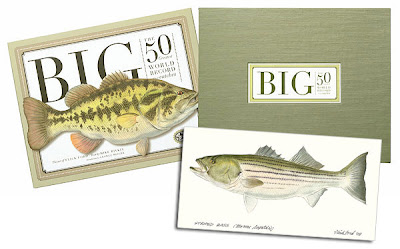
I really enjoy well made illustrations of fish, and this new book by Artist Flick Ford has really impressed me. You can view the illustrations and glean a bit of information if you check out Field and Stream's web page dedicated to the book BIG: The 50 Greatest World Record Catches . Of course putting aside the great illustrations and the well written citations I am a bit saddened to think that we may never see fish like this again. Even the well established rules for recreational anglers about size minimums may need to be revised. If we want to see fish like this again we need to implement rules to let the big fish live on. Scientist are beginning to support this kind of thinking to allow these fish to do what they do best. Reproduce in quantity. By taking larger fish we may be working on diminishing returns. If anyone is having a hard time finding me a birthday gift, may I suggest the limited collectors edition of BIG: The 50 Greatest World Record Catches for only $1350 Press rel...

IT AINT LIKE IT USED TO BE

From a New York fishmongers perspective, how things have changed. Since it has been nearly two months since my last musings here so much has happened. The market for seafood has gotten quite dismal with the wholesalers at the New Fulton Market in Hunts Point reduced to working on nickels and dimes when they can. Many companies have put crews on 4 day schedules, and games of cards and the occasional chess match fill the empty late night hours for lack of buyers. Not a day seems to go by that I here of fish being sold at ridiculously low prices, just so companies can avoid an outright loss. Many fish like Halibut have simply become too expensive an option for most, and restaurants have removed them from their menus. Back in favor Atlantic Salmon (a particularly great bargain with the ISA issues in Chile), tilapia, catfish, and skate. We are most of the way through Restaurant week here in the city (Restaurant Week is actually two weeks, many establishments are even extending it further.) ...

BYCATCH

Image
One of the MSC (Marine Stewardship Council) great success story has been the certification of the Alaskan Pollack fishery. Some 100 plus boats (factory type ships) harvest huge amounts of pollack under the watchful eyes of The MSC and the Alaska division of NOAA (National Oceanic and Atmospheric Agency). One problem is the huge amount of salmon bycatch that is inadvertently caught with the pollack. Strict guidelines currently have these boats discarding tons of fish. Surely there has to be some better way to handle all this bycatch. Below is today's AP article. Please cast your vote in the sidebar about bycatch. Associated Press/AP Online Enlarge Photo June 23, 2008 - ANCHORAGE, Alaska - Florence Johnson can rattle off myriad ways to prepare salmon. Drawing on a lifetime of fishing the Yukon River, she recommends canning, salting, or drying the fillets in her smokehouse near the heart of downtown Eagle. "I'd be very lost without it," Johnson said. "I ...

The Greenpeace List

Today Greenpeace released a report grading major U.S. supermarkets on sustainability. Most did not do well. The highest rated of the group Whole Foods received only four out of a possible 10. I was reminded about the presence of this report by an e-mail from Greenpeace despite the fact that I had not been a strong supporter of the group in the past. Hi Matthew! Over at Greenpeace I've been looking over tons of blogs on ocean conservation and seafood, ect., and yours has caught my eye. I thought you might be interested in our new report? From overfishing to bottom trawling to overcrowded fish farms, the seafood industry threatens our marine ecosystems to the point of collapse. Sustainable fishing is a key to maintaining healthy oceans which in turn help stabilize the planetary environment and the climate at large. Greenpeace has just released a unique report detailing the seafood purchasing practices of major American supermarkets, markets who make billions of dollars a...

Menhaden, and the Continuing Battle for the Food Chain

Image
As someone who makes a living trading in seafood for human consumption I have the opinion that the wholesale taking of a valuable natural resource by only a hand full of people is not good. Apparently there are even a few elected officials that are of the same opinion. I think that the effects of the Menhaden fishery is similar to the corn for ethanol scheme. By removing these fish from the food chain it no doubt effects the fish that rely on them for food. The other added benefit of that menhaden, and fish like them offer is the improvement of water quality as they filter feed upon algae, and detritus. Now that "Friend of the Sea" has sold them the sustainability label the fight to protect them might be harder. Below are two recent articles for your consideration: Taken from Asbury Park Press 5/16/2008 Bunker Bills Will Protect This Valuable Resource Two Republican congressmen are pushing legislation that would provide further protection to menhaden stocks that are so vit...

South Pacific Nations Adopt Tuna Moratorium

SeaFood Business May 21, 2008 - Eight South Pacific island nations on Tuesday agreed to block bigeye and yellowfin tuna fishing in the region's international waters. At the Fourth Forum Fisheries Ministerial Meeting in the Republic of Palau, eight nations - the Federated States of Micronesia, Kiribati, Marshall Islands, Nauru, Palau, Papua New Guinea, Solomon Islands and Tuvalu - agreed to prohibit licensed tuna vessels from fishing in two areas marked for protection beginning June 15. Environmental groups praised the decision. "It is the boldest move ever to prevent the overfishing of tuna. It is significant. It has really drawn a line," says Greenpeace campaigner Dean Baigent-Mercer. The nations identified so-called "doughnut holes" as waters that have been overexploited by tuna fishermen. One of the two areas is located north of Papua New Guinea, and the other is further east. Licensed boats operating in the protected waters will ...

Grow Fish In Your Basement

Image
Turned off by high seafood prices? Maybe the future of seafood is next to the washing machine or the water heater in your basement. It might seem like a far fetched idea, but it is one that increased transportation costs could bring closer to reality. The article below appeared in a recent Mother Earth News. USA.- For the past several years, the good folks at the Institute for Local Self-Reliance in Washington, D.C. have worked to help urban residents gain greater control over their lives through the use of low-technology, decentralist tools and concepts. [2008-02-22] We strongly believe that more people (city dwellers and country folk alike) should be exposed to the Institute's admirable efforts... which is why we've made this "what's happening where" report by ILSR staffers one of MOTHER'S regular features. Raising fish in the basement—as a means of producing a home supply of inexpensive protein—is an enticing idea to urban and rural dwellers a...

Sustainable Guidelines for Seafood

Just launched is a new site The Conservation Alliance for Seafood Solutions . This is just the kind of consolidation that we need. Now that some of those have gotten together to set some basic guidelines for all my fellow fishmongers, chefs, cooks, and consumers to take a good look at. One problem that has troubled the entire issue of seafood sustainability is the fragmented and confusing messages from a myriad of experts. By the way I am not an expert, just a concerned fishmonger trying to make a difference. When I was looking to label all the seafood I currently buy, sell, and stock I collected data from no less than a dozen organizations with different guidelines, I think we are moving in a a better direction. Though brand new, the site offers specific ideas for everyone to use in their efforts at a better future for the oceans. Below is the Alliance's press release Businesses Seeking Expertise from the Conservation Community Now Have Clear Steps for Moving Ahead on Sustainabl...

Sustainable Seafood Top Spring Picks

In no particular order, but with some leaning towards the northeast. All products should be consistently available fresh this spring and early summer. barramundi , farm raised, United States pollack , wild, mid-trawled, Atlantic and Pacific wild salmon , wild, seine net and line caught. catfish , farmed, United States pacific halibut, wild, line caught, United States and Canada mackerel, wild, net and line caught, Atlantic oysters, all varieties farmed and wild bay scallops, look for Taylor Bays and fresh Mexican bays Squid, wild, Worldwide clams and mussels, especially hand dug, or suspended, United States and Canada crayfish, wild and farmed, United States This list should provide any creative chef or home cook a season of recipes. Your comments and questions are welcome. I have provided links above to help answer some questions you may have. For more about sustainable seafood choices please visit one or more of these sites: Blue Ocean Institute Monterey Bay Seafood Choices Alliance