Posts

Showing posts with the label finfish

Sugar Toads, What? : Blowfish Tails Check

Image
So Friday morning I am on the phone with one of the good old boy fish sellers in Maryland, and after hearing about how the Maryland DNC might be the ones "poaching" all those rock fish (wild striped bass) in ghost driftnets he finally gives me his catch list, and he just says it 'sugar toads'. So I had to look at the calendar and make sure it wasn't April 1st, because I hate to admit it but I have no idea what this is. He says "..you know theses little puffer tails". The lights go on in my head: BLOWFISH TAILS.....send me 50 lbs to sell and a couple for testing. I have to say these are one of this Fishmonger's favorite appetizing seafood specialties, and no they are not poisonous that is a different fish. I cannot wait until these jewels arrive Monday. I did a little research and it looks like they are a 'micro-trend' according to a recent article in Grubstreet declares this, who knew. So if you get the chance try some at the next chance you...
Fish Yields - or - How Much Does This Really Cost Me?

Image
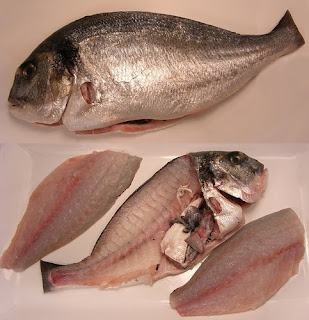
I often find it necessary to explain the yield (amount of usable flesh) off of various fish. By knowing what percentage of meat will be available when a whole fish is filleted one can make an accurate analysis of; A. how much whole fish must be purchased and B. what is the true fillet cost. Knowing how to correctly perform these calculations will benefit not only seafood suppliers, restaurant chefs, but also the casual cook. Below is a list of some common fish and the net yield percentages. Actual percentages may vary depending on skill of the butcher. Salmon (head-on gutted) yields 75% skin-on fillet Snapper (head-on gutted) yields 40% skin-on fillet Mahi (headed and gutted) yields 65% skin-on fillet Monkfish (tail) yields 70% skinless fillet Cod (headed and gutted) yields 60% skin-on fillet Grouper (head-on gutted) yields 35% skinless fillet Halibut (headed and gutted) yields 66% skin-on fillet Tuna (headless bullets) yields 75% untrimmed loins Sword (headless bullets) yields 80% cen...

Shrimp and Petroleum Festival

Image
All kidding aside there is actually a long standing festival in Louisiana that highlights the relationship between these two diverse industries and honors the hardworking men and women of both. Lets all hope that by the scheduled Labor Day weekend event that things are back to normal. Image from festival website. http://www.shrimp-petrofest.org/

"Local" Silver Dory

Image
Silver Dory, zenopsis conchifer (aka. American dory, local dory) is a deep water species of benthic fish that can be found in Atlantic waters, it is related to John Dory but differs in appearance being much more slender and compressed with monochromatic silver coloring in adults, and lacking the bold black "thumb print", although juveniles of this species may have similar light markings that fade with age. The dory is a good food fish with firm mild flavored white flesh and a fine flake. The fillets are rather thin and yield is only about 25% meat from whole fish. The range of this dory in the Americas is from Nova Scotia's Sable Island and south to the Carolinas. The silver dory is a deep water species and is found from 60 meters to 600 meters depths, most being found in depths near 150 meters on or near the continental shelf. There is no targeted fishery for dory and most are caught as incidental bycatch in deep water trawls (ie. deep water loligo squi...

Updated Monterey Bay Seafood Guide

The Monterey Bay Aquarium one of the driving forces behind sustainable seafood guides has just issued an updated list. Of particular interest is the downgrading of the Alaskan pollack fishery, and the the move of two farmed species: coho salmon, and shrimp. The changes do not come without outside criticism. As reported today in a SeafoodSource.com article highlighting the issue, the ratings were not entirely agreeable to Greenpeace, even if they did acknowledge the efforts and integrity of the MBA. Greenpeace spokesperson John Hocevar applauded the MBA’s decision. “I have a lot of respect for the work that the MBA put into their pollock report, and for the scientific rigor behind the Seafood Watch program in general,” he said. “While we don’t agree on everything, the aquarium’s recommendations are a valuable tool for seafood consumers. The MSC, meanwhile, is increasingly becoming a source of frustration as they certify, and re-certify, more and more fisheries that have significa...

Fall Seafood Suggestions

Image
Here is the short list of my recommended sustainable seafood choices for Fall. These selections should be readily available until the start of winter. As usual the list has an East Coast bias, my apologies to the West Coast. So in no particular order: bluefish: wild line caught, USA clams: wild or farmed, hand dredge, USA mussels: rope grown, Canada wild striped bass: wild caught and tagged, USA bay scallops: wild and farmed, hand dredge, USA and Mexico coho salmon: wild caught, USA and Canada wild shrimp: wild caught w/excluder devices, USA arctic char: closed system farmed, Canada and Iceland catfish: farmed, USA sable fish: wild caught, USA

Tag Those Fish for Cash and Sustainability

Image
I think this is brilliant, and a harbinger of things to come. Maybe some of our East Coast fishermen will try this here. If you are a local fisherman here in the Northeast give me a call I want your well handled hand-lined fish. Story below from Seafood Source. Tagged sea bass, lobster deliver price premium By Lindsey Partos, SeafoodSource contributing editor, reporting from Paris 8/5/2009 11:03:46 AM - South East England fishermen participating in a trial tagging scheme are receiving premium prices for their line-caught sea bass and pot-harvested lobsters . Under the aegis of the South East Seafood Group, the trial is designed to promote the region’s inshore fishing fleet as a source of high-end, locally caught seafood. “The main driver for the tags is full traceability,” David Marshall of fisheries consulting firm Fathom Marine, which is leading the initiative, told SeafoodSource. Consumer demand for traceable seafood products is accelerating, he added. “Up until now,...

The Stripers are Coming

Image
Wild striped bass season opened July 1st for New York commercial fishermen. While we have had striped bass in the New York market for some time the opening of the local fish will help drive prices downward. Look for prices to drop after Independence day. Striped bass ( Morone saxatilis ), also known as rockfish to some are one of the east coasts most valuable species. Striped bass was once over fished but over the past ten years most states have implemented strict guidelines for the commercial sales of this fish as well as fair catch limits for the recreational fisherman. However this fragmented regulation from state top state has made enforcement difficult. Below is a list of some Northeast state regulations. Rhode Island trap: 26" min general category: 34" min New York 24" - 36" Delaware 28" min 20" special spring season 3/1-3/30 Maryland Bays and Rivers: 18"-36" Ocean: 24" PRFC ( Potomac River Fisheries Commission ) 18" min al...

SUSTAINABLE SPRING SEAFOOD SUGGESTIONS

In no particular order, but with some leaning towards the northeast. All products should be consistently available fresh this spring and early summer. barramundi , farm raised, United States pollack , wild, mid-trawled, Atlantic and Pacific wild salmon , wild, seine net and line caught. catfish , farmed, United States pacific halibut , wild, line caught, United States and Canada mackerel , wild, net and line caught, Atlantic oysters, all varieties farmed and wild bay scallops, look for Taylor Bays and fresh Mexican bays Squid, wild, Worldwide clams and mussels, especially hand dug, or suspended, United States and Canada crayfish, wild and farmed, United States Arctic Char , farmed Canada and Iceland. This list should provide any creative chef or home cook a season of recipes. Your comments and questions are welcome. I have provided links above to help answer some questions you may have. For more about sustainable seafood choices please visit one or more of these sites: Blue Ocean Ins...

Aquaculture Efficiencies

Image
It is estimated that in the near future ( some put the date at 2050 ) our oceans will no longer be able to support the growing seafood demand. In order to keep pace with demand fish farming (aquaculture) production is sure to increase. Now despite all the bad publicity that fish like farmed salmon receive, there are aquaculture operations that are on the cutting edge of sustainability. One in particular is Kona Blue Water Farms , where they raise Kona Kamapchi ( Seriola rivoliana ) a fish that would be known as Almaco Jack or kahala in the wild. I recently read a report they released that shows that the feed efficiency for farmed fish may in fact surpass wild fish. While the jury is still out because the report is subjective, I applaud the effort. Kona Blue is indeed doing the right thing and have received a lot of attention for the high level of stewardship they exhibit. What follows is the press release. Kona Kampachi® - 60 Times Less Impact on Stocks than Wild-Caught Fish S...

Earth Day 2009

Image
Today is Earth day. The Earth is composed of mostly water. Therefore today should be mostly about water. I hope you do not mind my philosophical stretch. But how can you blame me since the fishmonger must be focused on the seas and such? Let us not make light of today's significance, even though I may not agree with many that take a particular extreme view of today's environmental issues, PETA for one. I for one enjoy eating seafood, and I am especially invested in the seafood industry for my livelihood. I just believe that protection does not exclusively rule out enjoyment. If you are a first time visitor please take a moment to look around. I hope that you enjoy my musings and smattering's of actual information. I welcome, actually I encourage your comments and questions be they friendly or otherwise. Actually I hope to expand the content here with additional authors, so stay tuned. And happy Water, eh.. Earth Day.

Seafood Tidbits

Image
French fishermen protest quotas by blocking transit. Chinese could eat all of Florida's turtles. Shad and the wheels of politics, fortune wanes.

Accepting the Challenges of Sustainable Seafood

I am always glad to see seafood sustainability in the public realm. I was inspired by this recent New York Times editorial .Like many issues today there is, as the author points out, a lot of confusion and bad information being bantered about. There is unfortunately a perception that farmed is bad (sometimes true) and that wild caught is better (not always the case). I am a fishmonger in New York and even some of the most savvy chefs are just starting to address this issue. Much of the problem of seafood sustainability I think is the general disconnect that the American consumer has developed with food. When I try to sell some sustainable species like mackerel (a small oily and relatively abundant fish) I hear that people do not like it. The truth might be that they won't try it. My advice: 1. Get a seafood guide for your local. Blue Ocean Institute is great for the Northeast. Monterey Bay is better if you live near the Pacific . 2.Get to know your fishmonger. Ask lots of questio...

Did I Mention Catfish?

Image
Here is an idea for some domestic economic stimulus. Buy and eat United States produced Catfish. Not only will it keep those dwindling dollars here in the states, but it is delicious to boot. And pretty darn sustainable too. So there you have it just stop buying overpriced farmed salmon and give reasonably priced catfish a try.

Hey Salmon Producers Give Me a Break

I used to enjoy watching John Stossel on 20/20 and his Give Me A Break segments. I even had the opportunity to attend a dinner at Stetson Law where he spoke. I wonder what he would say about the current state of the Salmon industry. That most of the Industrial Salmon Complex are owned by few companies leads one to ponder conspiracy theories. We are all guilty for enjoying the relatively inexpensive farm raised Atlantic salmon during its hey day. The American people generally ignored all the bad press the lowly salmon had to take. Food writers and scientists alike criticized the fish because of the way in which it was raised, that it was dyed or color added, and that it was contaminated with toxins, or that it just didn't taste as good. Maybe Top Chef contestant and finalist Stefan will forget all he thinks he knows about farmed salmon after his disappointing showing cooking or overcooking as the judges determined lean wild coho salmon. Despite all its bad press most people love the...
Image
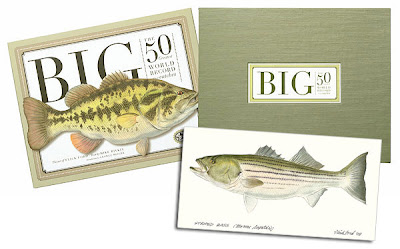
I really enjoy well made illustrations of fish, and this new book by Artist Flick Ford has really impressed me. You can view the illustrations and glean a bit of information if you check out Field and Stream's web page dedicated to the book BIG: The 50 Greatest World Record Catches . Of course putting aside the great illustrations and the well written citations I am a bit saddened to think that we may never see fish like this again. Even the well established rules for recreational anglers about size minimums may need to be revised. If we want to see fish like this again we need to implement rules to let the big fish live on. Scientist are beginning to support this kind of thinking to allow these fish to do what they do best. Reproduce in quantity. By taking larger fish we may be working on diminishing returns. If anyone is having a hard time finding me a birthday gift, may I suggest the limited collectors edition of BIG: The 50 Greatest World Record Catches for only $1350 Press rel...

Affordable Seafood, Boston Mackerel

Image
Seafood can be an affordable dining choice. So with that in mind here is one fish that you should consider putting on your menu, Boston mackerel. This small member of the mackerel family Scomber scombrus is also known by some other names such as Atlantic mackerel, tinker, or simply mackerel. A favorite fish in the United Kingdom and Europe it is barely on the radar to American chefs and consumers. Atlantic mackerel is often sold in tins or smoked. The tinned product makes an excellent and more flavorful alternative to canned tuna. Try to find one packed in olive oil and use it like you would tuna in your favorite salad recipe. Try a mackerel nicoise salad. Smoked fish is always a winner and the rich flavor of mackerel is enhanced with the addition of salt and hardwood smoke, it is great on its own or made into a dip. Fresh fillets can be quickly sauteed and served with simple garnishes for a truly delicious and elegant meal. Mackerel is high in healthy omega oils, selenium and low in ...

The Frozen Myth

Image
Ja pan is the world leader in seafood consumption and most of that is frozen. So does the entire country of Japan know something we here in the States don’t? The simple answer, yes they do. But we all may have good reason to doubt. Many chefs simply have not had good experience with frozen seafood, and even those that use frozen shrimp or frozen squid on a daily basis are reluctant to try frozen fin fish. What gives? Well for so many years frozen was synonymous with low grade waterlogged commodity fish that gave frozen fish as a class a real bad rep. But today there are a few products that equal or surpass the quality of fresh, or as Bruce Gore a leader and pioneer in boat frozen wild salmon likes to call” fresh”...refrigerated. I remember that first conversation with Bruce as he constantly corrected me every time I told him about the fresh wild salmon we were bringing in. Although it is possible to have very fresh west coast product in New York because of the miracle of flight....

Open Ocean Aquaculture Debate

Image
A well thought out plan to farm native species fish in open ocean pens in United States waters could be a solution to more than one problem facing us today. Or it could be the worst idea to come since we allowed untreated waste to be dumped into the water from heavy manufacturing. Pros Reduces the need to consume wild caught food fish. Creates much needed employment in coastal communities. Promotes innovation and technology. Reduces dependency on imported aquaculture. Cons Waste from fish farming impacts local ecology. Greater demand on wild forage fish as food for aquaculture fish. Disease and escapement jeopardize wild stock. Creates confusion in the market with identical wild and farmed fish species. This debate is far from over, and I am sure all sides will weigh in on this issue. I for one would allow some progress on this to occur on a very limited basis. By allowing some ocean open farming to occur we could better understand how to meet the growing demands of the seafood consume...

Raw Swordfish to Replace Bluefin

Image
Japan is set to test the consumers reaction to raw swordfish in place of bluefin. I for one have seen too many swordfish and the organisms that live inside them to ever contemplate swordfish sushi . And without debating, wasn't swordfish the recent poster child of giving fish a break. The second brilliant plan many have is to farm or ranch tuna. Most of the problems here involves either taking juvenile fish from the wild or the huge amount of forage fish that are required to feed these carnivores.